 Add to Chrome
 Add to Firefox
 Add to Edge
Representation Forcing for Bottleneck-Free Unified Multimodal Models
May 29, 2026
Unified multimodal models (UMMs) aim to handle perception and generation in a single model. Yet existing UMMs still rely on a frozen, separately pretrained VAE for image generation, imposing a structural bottleneck. Naively removing it introduces a quality gap, as the model must learn both high-level structure and low-level details from raw pixels. In this paper, we propose Representation Forcing (RF), a technique that closes this gap by making representation prediction a native capability of the model. Concretely, RF forces the decoder to autoregressively predict visual representations as intermediate tokens before pixels; these tokens then stay in context to guide pixel diffusion within the same backbone. By turning representations from perception outputs into generation targets, RF eliminates the need for any external generative latent space. We find that RF benefits both understanding and generation. On image generation, our pixel-space model with RF matches state-of-the-art VAE-based unified models. On image understanding, pixel-space RF generally outperforms its VAE-based variant. Together, these results offer an effective step toward end-to-end, bottleneck-free UMMs.

Context Unrolling in Omni Models
Apr 23, 2026We present Omni, a unified multimodal model natively trained on diverse modalities, including text, images, videos, 3D geometry, and hidden representations. We find that such training enables Context Unrolling, where the model explicitly reasons across multiple modal representations before producing predictions. This process enables the model to aggregate complementary information across heterogeneous modalities, facilitating a more faithful approximation of the shared multimodal knowledge manifold and improving downstream reasoning fidelity. As a result, Omni achieves strong performance on both multimodal generation and understanding benchmarks, while demonstrating advanced multimodal reasoning capabilities, including in-context generation of text, image, video, and 3D geometry.
ConflictBench: Evaluating Human-AI Conflict via Interactive and Visually Grounded Environments
Mar 09, 2026As large language models (LLMs) evolve into autonomous agents capable of acting in open-ended environments, ensuring behavioral alignment with human values becomes a critical safety concern. Existing benchmarks, focused on static, single-turn prompts, fail to capture the interactive and multi-modal nature of real-world conflicts. We introduce ConflictBench, a benchmark for evaluating human-AI conflict through 150 multi-turn scenarios derived from prior alignment queries. ConflictBench integrates a text-based simulation engine with a visually grounded world model, enabling agents to perceive, plan, and act under dynamic conditions. Empirical results show that while agents often act safely when human harm is immediate, they frequently prioritize self-preservation or adopt deceptive strategies in delayed or low-risk settings. A regret test further reveals that aligned decisions are often reversed under escalating pressure, especially with visual input. These findings underscore the need for interaction-level, multi-modal evaluation to surface alignment failures that remain hidden in conventional benchmarks.
Unraveling the Hidden Dynamical Structure in Recurrent Neural Policies
Feb 01, 2026Recurrent neural policies are widely used in partially observable control and meta-RL tasks. Their abilities to maintain internal memory and adapt quickly to unseen scenarios have offered them unparalleled performance when compared to non-recurrent counterparts. However, until today, the underlying mechanisms for their superior generalization and robustness performance remain poorly understood. In this study, by analyzing the hidden state domain of recurrent policies learned over a diverse set of training methods, model architectures, and tasks, we find that stable cyclic structures consistently emerge during interaction with the environment. Such cyclic structures share a remarkable similarity with \textit{limit cycles} in dynamical system analysis, if we consider the policy and the environment as a joint hybrid dynamical system. Moreover, we uncover that the geometry of such limit cycles also has a structured correspondence with the policies' behaviors. These findings offer new perspectives to explain many nice properties of recurrent policies: the emergence of limit cycles stabilizes both the policies' internal memory and the task-relevant environmental states, while suppressing nuisance variability arising from environmental uncertainty; the geometry of limit cycles also encodes relational structures of behaviors, facilitating easier skill adaptation when facing non-stationary environments.
Physiology as Language: Translating Respiration to Sleep EEG
Jan 31, 2026This paper introduces a novel cross-physiology translation task: synthesizing sleep electroencephalography (EEG) from respiration signals. To address the significant complexity gap between the two modalities, we propose a waveform-conditional generative framework that preserves fine-grained respiratory dynamics while constraining the EEG target space through discrete tokenization. Trained on over 28,000 individuals, our model achieves a 7% Mean Absolute Error in EEG spectrogram reconstruction. Beyond reconstruction, the synthesized EEG supports downstream tasks with performance comparable to ground truth EEG on age estimation (MAE 5.0 vs. 5.1 years), sex detection (AUROC 0.81 vs. 0.82), and sleep staging (Accuracy 0.84 vs. 0.88), significantly outperforming baselines trained directly on breathing. Finally, we demonstrate that the framework generalizes to contactless sensing by synthesizing EEG from wireless radio-frequency reflections, highlighting the feasibility of remote, non-contact neurological assessment during sleep.
Signal-Adaptive Trust Regions for Gradient-Free Optimization of Recurrent Spiking Neural Networks
Jan 29, 2026Recurrent spiking neural networks (RSNNs) are a promising substrate for energy-efficient control policies, but training them for high-dimensional, long-horizon reinforcement learning remains challenging. Population-based, gradient-free optimization circumvents backpropagation through non-differentiable spike dynamics by estimating gradients. However, with finite populations, high variance of these estimates can induce harmful and overly aggressive update steps. Inspired by trust-region methods in reinforcement learning that constrain policy updates in distribution space, we propose \textbf{Signal-Adaptive Trust Regions (SATR)}, a distributional update rule that constrains relative change by bounding KL divergence normalized by an estimated signal energy. SATR automatically expands the trust region under strong signals and contracts it when updates are noise-dominated. We instantiate SATR for Bernoulli connectivity distributions, which have shown strong empirical performance for RSNN optimization. Across a suite of high-dimensional continuous-control benchmarks, SATR improves stability under limited populations and reaches competitive returns against strong baselines including PPO-LSTM. In addition, to make SATR practical at scale, we introduce a bitset implementation for binary spiking and binary weights, substantially reducing wall-clock training time and enabling fast RSNN policy search.
When Personalization Legitimizes Risks: Uncovering Safety Vulnerabilities in Personalized Dialogue Agents
Jan 25, 2026Long-term memory enables large language model (LLM) agents to support personalized and sustained interactions. However, most work on personalized agents prioritizes utility and user experience, treating memory as a neutral component and largely overlooking its safety implications. In this paper, we reveal intent legitimation, a previously underexplored safety failure in personalized agents, where benign personal memories bias intent inference and cause models to legitimize inherently harmful queries. To study this phenomenon, we introduce PS-Bench, a benchmark designed to identify and quantify intent legitimation in personalized interactions. Across multiple memory-augmented agent frameworks and base LLMs, personalization increases attack success rates by 15.8%-243.7% relative to stateless baselines. We further provide mechanistic evidence for intent legitimation from internal representations space, and propose a lightweight detection-reflection method that effectively reduces safety degradation. Overall, our work provides the first systematic exploration and evaluation of intent legitimation as a safety failure mode that naturally arises from benign, real-world personalization, highlighting the importance of assessing safety under long-term personal context. WARNING: This paper may contain harmful content.
End-to-End Training for Autoregressive Video Diffusion via Self-Resampling
Dec 17, 2025
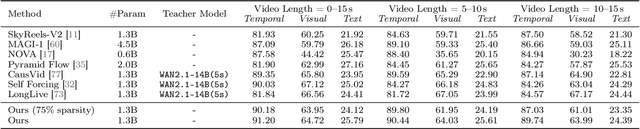
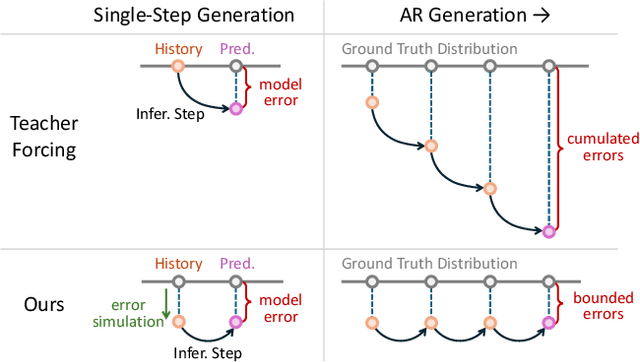
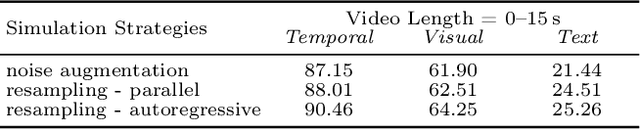
Autoregressive video diffusion models hold promise for world simulation but are vulnerable to exposure bias arising from the train-test mismatch. While recent works address this via post-training, they typically rely on a bidirectional teacher model or online discriminator. To achieve an end-to-end solution, we introduce Resampling Forcing, a teacher-free framework that enables training autoregressive video models from scratch and at scale. Central to our approach is a self-resampling scheme that simulates inference-time model errors on history frames during training. Conditioned on these degraded histories, a sparse causal mask enforces temporal causality while enabling parallel training with frame-level diffusion loss. To facilitate efficient long-horizon generation, we further introduce history routing, a parameter-free mechanism that dynamically retrieves the top-k most relevant history frames for each query. Experiments demonstrate that our approach achieves performance comparable to distillation-based baselines while exhibiting superior temporal consistency on longer videos owing to native-length training.
Does AI-Assisted Coding Deliver? A Difference-in-Differences Study of Cursor's Impact on Software Projects
Nov 13, 2025Large language models (LLMs) have demonstrated the promise to revolutionize the field of software engineering. Among other things, LLM agents are rapidly gaining momentum in their application to software development, with practitioners claiming a multifold productivity increase after adoption. Yet, empirical evidence is lacking around these claims. In this paper, we estimate the causal effect of adopting a widely popular LLM agent assistant, namely Cursor, on development velocity and software quality. The estimation is enabled by a state-of-the-art difference-in-differences design comparing Cursor-adopting GitHub projects with a matched control group of similar GitHub projects that do not use Cursor. We find that the adoption of Cursor leads to a significant, large, but transient increase in project-level development velocity, along with a significant and persistent increase in static analysis warnings and code complexity. Further panel generalized method of moments estimation reveals that the increase in static analysis warnings and code complexity acts as a major factor causing long-term velocity slowdown. Our study carries implications for software engineering practitioners, LLM agent assistant designers, and researchers.
Speed at the Cost of Quality? The Impact of LLM Agent Assistance on Software Development
Nov 06, 2025Large language models (LLMs) have demonstrated the promise to revolutionize the field of software engineering. Among other things, LLM agents are rapidly gaining momentum in their application to software development, with practitioners claiming a multifold productivity increase after adoption. Yet, empirical evidence is lacking around these claims. In this paper, we estimate the causal effect of adopting a widely popular LLM agent assistant, namely Cursor, on development velocity and software quality. The estimation is enabled by a state-of-the-art difference-in-differences design comparing Cursor-adopting GitHub projects with a matched control group of similar GitHub projects that do not use Cursor. We find that the adoption of Cursor leads to a significant, large, but transient increase in project-level development velocity, along with a significant and persistent increase in static analysis warnings and code complexity. Further panel generalized method of moments estimation reveals that the increase in static analysis warnings and code complexity acts as a major factor causing long-term velocity slowdown. Our study carries implications for software engineering practitioners, LLM agent assistant designers, and researchers.